

For a long time, we have designed digital intelligence as something centralized. Data was collected at the edges of the organization and transported inward. Analysis happened in core systems, data centers, or cloud platforms. Decisions followed, often mediated by dashboards, reports, meetings, and human interpretation. It was a model built around the assumption that time, connectivity, and human attention would always be available.
That assumption is now being tested.
More and more of the decisions that shape daily operations must be made in real time, under uncertainty, and in close proximity to where events actually occur. Machines operate faster than humans can intervene. Supply chains shift dynamically. Infrastructure balances itself second by second. Customers interact through channels that expect immediate response. In this environment, intelligence that lives far away from the point of action becomes a limitation rather than an asset.
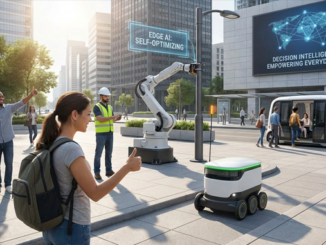
This is where Edge AI quietly enters the picture, not as a technological novelty, but as a structural correction. At its surface, Edge AI is often described in technical terms. AI models deployed closer to sensors, devices, machines, or users. Lower latency. Reduced bandwidth usage. Improved resilience. These are all true, but they miss the deeper implication. What truly changes is not where computation happens, but where decisions are allowed to emerge. When intelligence is placed at the edge, systems no longer wait for permission from a distant center. They perceive, interpret, and act within their local context. A production line adjusts itself. An energy system balances load autonomously. A vehicle responds to its surroundings without constant external guidance. Action becomes immediate, contextual, and continuous.
This shift introduces a new kind of architectural tension. Centralized intelligence has always been attractive because it offers control, consistency, and oversight. Edge intelligence, by contrast, introduces distribution, autonomy, and variability. At first glance, this can feel unsettling. Leaders often ask where control resides when decisions are no longer routed through a single point. The instinctive response is to pull intelligence back toward the center.
Yet the organizations that progress tend to move in the opposite direction.
What they begin to realize is that Edge AI does not remove control, it reshapes it. Control moves from approving individual actions to defining the boundaries within which action may occur. Instead of asking systems to wait, leaders begin to ask different questions. Under what conditions should a system act on its own? What risks are acceptable locally, and which require escalation? How do we ensure alignment without micromanagement?
These questions mark a subtle evolution in leadership thinking. Authority is no longer exercised through constant intervention, but through design. Strategy starts to express itself through constraints, policies, and intent rather than through instructions. In this sense, Edge AI is as much an organizational shift as it is a technical one. It is also here that the limits of Edge AI become visible. Intelligence at the edge is powerful, but without coherence it risks fragmentation. Local decisions must still align with global objectives. Actions must remain auditable, explainable, and accountable. This is why Edge AI rarely stands alone in mature implementations. It increasingly operates in dialogue with decision intelligence at a higher level, where goals, priorities, and decision logic are shaped.
Seen through this lens, Edge AI is not about replacing centralized intelligence, but about redistributing it. Some decisions belong close to the action. Others belong at a strategic level. The art lies in knowing which is which, and designing the handover points with care.

What is particularly interesting is how this redistribution unfolds in practice. Organizations rarely begin by granting full autonomy. They experiment. Systems observe before they act. Recommendations precede execution. Human oversight remains present, sometimes actively, sometimes in the background. As confidence grows, autonomy expands. When trust is broken, boundaries tighten again. This gradual approach is not a weakness. It is how trust is built in complex socio-technical systems. Edge AI earns its role through consistency, not promise. As this pattern repeats across domains, something larger starts to take shape. Decision-making itself becomes layered. Some choices are made locally, instantly, and repeatedly. Others remain centralized, deliberate, and infrequent. Intelligence becomes distributed, but direction remains shared. The organization begins to resemble a living system rather than a command structure.
This is why Edge AI is such a critical foundation for what comes next. Without intelligence near the point of action, autonomy remains theoretical. Without real-time perception and response, agentic systems cannot function meaningfully. Edge AI is where digital systems first learn to act responsibly in the real world.
In the next article, I will turn to the second foundational layer in this shift: decision intelligence. While Edge AI determines where intelligence lives, decision intelligence determines how decisions are shaped, governed, and trusted. Together, they set the stage for systems that do more than analyze reality. They begin to participate in it. What we are witnessing is not the collapse of central control, but its evolution. Intelligence is no longer confined to the center. It is learning how to live at the edges, closer to reality, and closer to consequence.
And that changes everything.



Be the first to comment