
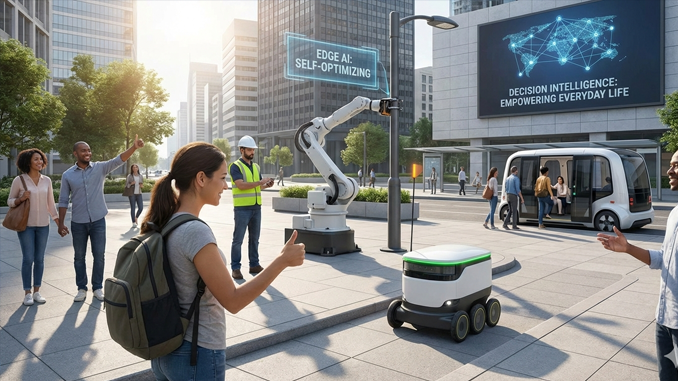
There are moments in the history of technology that do not feel dramatic while they are happening. No major launches, no sudden paradigm shifts that everyone immediately recognizes. Yet it is often in these quiet transitions that the most profound changes take shape. I believe we are living through such a moment right now. For many years, digital transformation has been about becoming more data-driven. We have built systems for data collection, analysis, and visualization. We have learned to make better decisions through dashboards, reports, and predictive analytics. The underlying assumption has been clear: if we can see the world more clearly, we will act more intelligently.
But something is beginning to change!
Increasingly, the real constraint is no longer insight, but friction. The distance between understanding and action. The time it takes to turn analysis into decisions. The handoffs, approvals, and uncertainties around who should act, when, and on what basis. As organizations operate in environments that are faster, more interconnected, and more real-time, this friction becomes impossible to ignore.
This is where a new constellation of technologies and ideas begins to emerge, still lacking a single, widely accepted label, but already reshaping how digital systems are conceived. Decision intelligence, Edge AI, and what are often referred to as agentic systems are not independent trends. They are expressions of the same underlying movement. A movement where intelligence no longer merely produces insight, but increasingly participates in action.
To understand where this is heading, it helps to step back.
Historically, intelligence in digital systems has been centralized. Data is gathered from operations, transported to central platforms, analyzed in the cloud or in data centers, and presented to humans who then make the decisions. This model has served organizations well, but it assumes that time, context, and human attention are always available. Today, we see the limitations of that assumption. Many decisions must be made quickly, locally, and sometimes without the opportunity for human involvement in that moment. This is where Edge AI becomes more than just another technical buzzword. When intelligence is placed closer to processes, machines, users, and events, the very logic of decision-making changes. Action can occur where reality unfolds, not after the fact.
Yet intelligence at the edge is not enough on its own. Systems that act without clearly defined principles quickly become opaque or even unsafe. This is why decision intelligence is emerging in parallel, as a way to make decisions explicit, modelable, and governable. Not as insights in reports, but as decision logic embedded directly into processes and systems. This is a subtle but fundamental shift. When decisions themselves become digital assets, leadership changes character. Attention moves away from approving individual actions and toward shaping boundaries, objectives, risk tolerances, and guiding principles. Strategy begins to manifest through how systems are allowed to act, not only through plans and documents.
It is at this point that the most misunderstood concept enters the discussion: AI agents and agentic systems. They are often portrayed as something radically new, almost as autonomous digital actors suddenly stepping onto the stage. In reality, they are better understood as a result of maturity. When intelligence exists close to the real world, when decisions are explicitly designed and governed, and when trust has been built through experience, autonomy becomes possible. And trust is the slow, human dimension of this transformation. Organizations do not hand over decisions to systems easily. They test. They compare outcomes. They run systems in parallel with humans. Automation is allowed first in low-risk domains. When it works consistently, mandates expand. When it fails, boundaries are adjusted. This is a learning process, both technical and psychological.
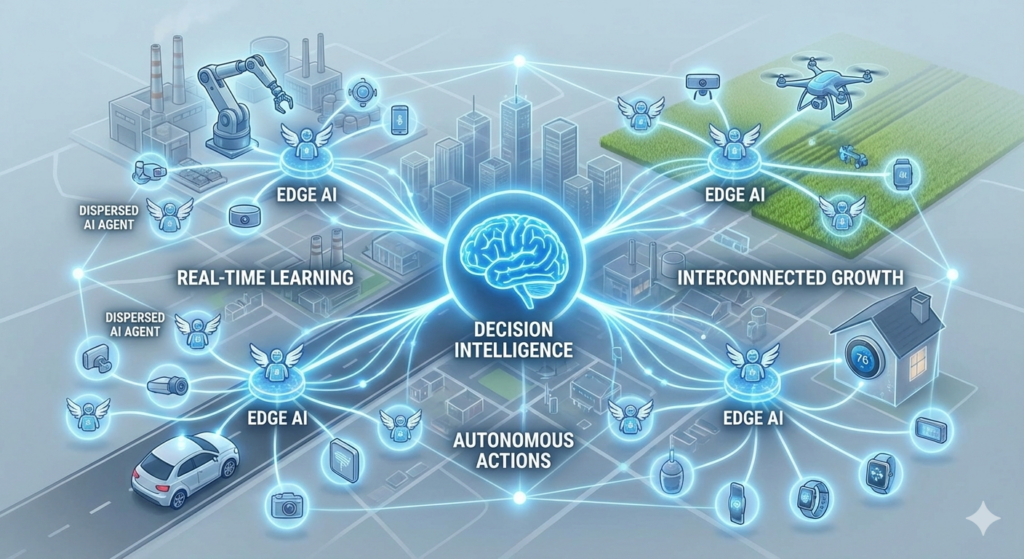
That is also why this shift rarely feels dramatic. It unfolds quietly through pilots, operational systems, and subtle changes at the interface between human judgment and machine action. Yet the implications are profound. Organizations that succeed in building these intelligent, learning structures do not merely gain efficiency. They gain speed, resilience, and an entirely different ability to translate strategy into action. We are still early in this journey. Many speak about these technologies in isolation. Few place them into a coherent narrative. Fewer still reflect on what this means for how organizations are designed, governed, and led over time. This article series is an attempt to explore that terrain.
In the coming pieces, I will dive deeper into three critical dimensions. First, how intelligence is moving into the real world through Edge AI. Second, how decision intelligence turns decision-making into a governable capability. And finally, how agentic systems emerge through controlled autonomy and gradually built trust. This is not speculative science fiction. Much of this can already be seen, tested, and experimented with today. But the full picture is not yet obvious. Perhaps that is precisely why this moment is so interesting.
Sometimes it is not the loud breakthroughs that change everything, but the quiet shifts that slowly move intelligence to where the world actually happens.




Be the first to comment