

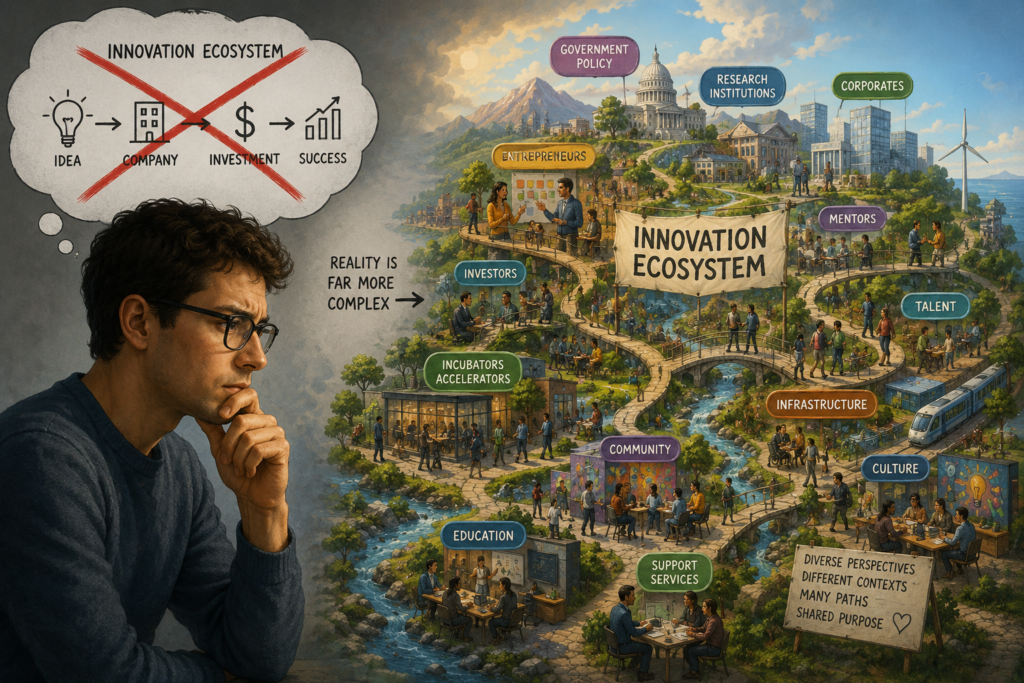
I have been wrong about innovation ecosystems for twenty years. Not entirely wrong, but wrong enough that it bothers me now that I see it. Let me explain.
For most of my career — as a researcher, as a consultant, as someone who has sat in more rooms with regional directors and corporate innovation leads than I care to count — I have operated under the same general assumption everyone else has. To build an innovation ecosystem, you build the things an innovation ecosystem visibly contains. Labs. Hubs. Seed funds. Science parks. Accelerators. Add talent attraction and a tax incentive or two, and the network will form. I have helped design those things. I have advised on them. I have written maturity models for them. In retrospect, I have probably been part of the problem more often than part of the solution. And I keep running into the same conversation. A regional innovation director — sometimes a science park CEO, sometimes a corporate innovation lead — wants to discuss the next investment round. Another fund. Another hub. Another accelerator program. The conversation goes perfectly well until I make the mistake of asking what will actually be different afterwards. That is when the room gets quiet. In my early consulting years I would have answered the question myself, confidently. I would have told them that with the right combination of physical infrastructure and risk capital, ecosystem activity would accelerate. I would have produced a deck. I might have produced a maturity model. (Spoiler: I did produce a maturity model.) Then I would have gone home, the room would have nodded in approval, and someone, somewhere, would have funded another building. We all felt very productive.
The methodology applied
For the last year, while developing the conceptual base for a book I am writing on innovation ecosystem architecture, I have done something I had never gotten around to doing in twenty years of doing this work. I have actually been counting what is inside an innovation ecosystem. I gathered roughly 570 individual services, programs, and methods offered across a full innovation process — from opportunity identification all the way to value distribution after launch. I normalized those into one hundred and seventy-eight typed offerings. And I tagged each one with the kind of resource it primarily provides.
The ratio that came out was uncomfortable.
The results
Three quarters of an innovation ecosystem’s operational supply is knowledge and relations. The remaining quarter — capital, infrastructure, materials, time, all of them combined — is twenty-four percent. 76% against 24%. It does not match the way most regional and corporate ecosystem strategies I have been involved with have been designed. It does, however, match something I should have remembered from my Living Labs days back in the late 2000s, when the whole methodology was built around the idea that knowledge transfer happens in patient, embodied, multi-year relationships between users, developers, and institutions. We knew this then. Somewhere along the way, in the rush toward funds and hubs and impressive groundbreaking ceremonies, a lot of us seem to have forgotten.
What is means
There is an analogy from my old life that fits here, even if it is not the most dignified one. When people start training kickboxing they tend to think what they need is the right gym, the right gear, and a coach with a famous name. Those things help. But none of them are what makes you good. What makes you good lives somewhere between the thousand hours with a specific coach who has watched your specific mistakes long enough to predict them, the sparring partners whose timing your body has learned in particular ways, and the slow accumulation of pattern recognition that nobody can hand you in a workshop. It is not stockable. It does not arrive on a procurement timeline. It accumulates only with people who stay long enough to actually know what they are doing in this specific context. Innovation ecosystems are the same. The fund and the building are gear. The coaches — the operators who have been in the same region for years, who know this particular set of firms and its particular regulators and its particular history of grudges and partnerships — are what does the actual work. We keep buying gear. We keep being mildly surprised when the network does not form on its own. The infrastructure-and-capital playbook addresses, at best, a quarter of what the ecosystem actually trades in. The other three quarters have always been there. They have just been invisible to the instruments we have agreed to use.
I am still working through what this means in practice, and I will write about it in installments as the work develops. The most immediately uncomfortable implication is for those of us who advise regions and companies on ecosystem development. The standard consulting product is a methodology, a framework, a maturity model. (I have produced all three. I am sorry.) What the catalog suggests is that those products address the visible quarter and quietly leave the invisible three quarters to do as it pleases — which it then does, often badly. This has made me a less confident person to sit across from in an advisory meeting, which I think is probably progress. The next time a regional director asks what to fund next, I am going to ask what the plan is for keeping the people who already know how to do the work. If the answer is that no such plan exists — and it almost never does — at least we will both know we are talking about the right ecosystem, and not just the visible one.
Tadaa!

This is the first in a series of posts drawing on the Innovation Ecosystem Architecture framework, the conceptual base of a book in progress. More on the framework as the work develops.



1 Trackback / Pingback