
Innovation ecosystem. Cluster. Innovation district. Innovation hub. Network. Platform. Living Lab. Anyone who has spent time in innovation policy or corporate strategy over the last decade will recognize the ritual: we start a conversation about “the ecosystem”, drift into “our cluster”, refer to “the innovation hub down the road”, nod knowingly at “the digital platform” someone is building, and end up in agreement without anyone quite knowing what we agreed to.
I have been part of that ritual for twenty years, in a bunch of advisory rooms. In my defense, so has almost everyone else in the profession. In my less flattering defense, I have also produced enough decks that used these words interchangeably that I have been, on any honest reading, part of the problem. So I went back to the literature over the last months, partly to sort out my own confusion, and I think I finally have a way of looking at this that is both intellectually honest and practically useful.
The confusion, it turns out, is not that the words mean the same thing. The confusion is that they mean different things — and we have been treating them as substitutes rather than as layers.
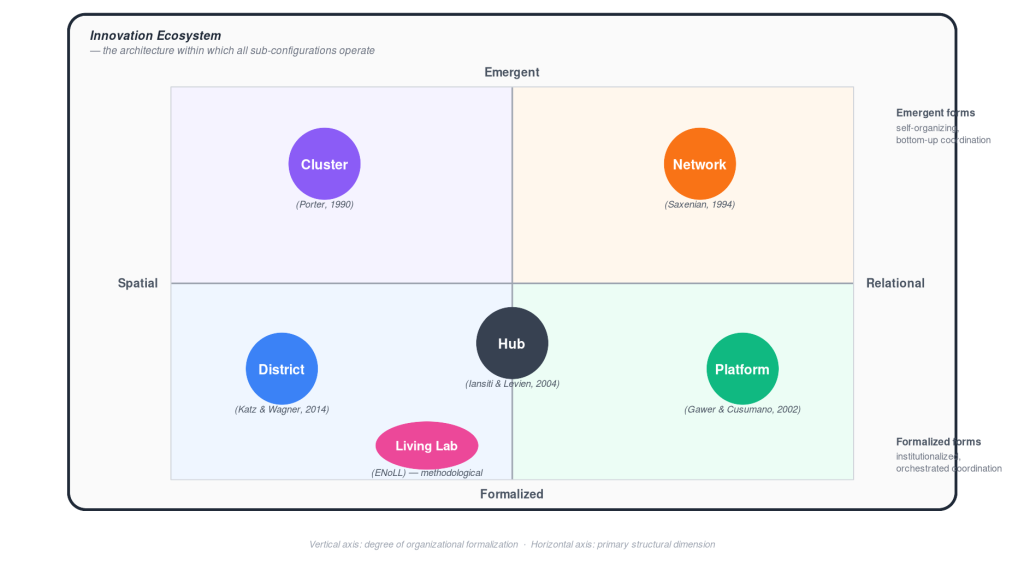
Michael Porter’s original definition of a cluster, from The Competitive Advantage of Nations in 1990 and refined in his 1998 Harvard Business Review piece, is quite specific: “a geographically proximate group of interconnected companies and associated institutions in a particular field, linked by commonalities and complementarities”. It requires physical closeness. It rests on shared technologies and specialised labour markets. It is not a metaphor. Fourteen years later, Marco Iansiti and Roy Levien introduced the business ecosystem to strategy thinking with The Keystone Advantage — and they used a completely different set of primitives. Their ecosystems have hubs and platforms and keystones and niche players inside them. Cross-industry. Geography does not define them. Roles do. Read those two books alongside each other and it becomes obvious that Porter and Iansiti-Levien are not describing competing ideas. They are describing different layers of the same architecture. A cluster is a geographical coordination form. A hub is a role within an ecosystem — a place where structural connections concentrate. Bruce Katz and Julie Wagner made this explicit in their 2014 report The Rise of Innovation Districts: an innovation district is a geographic area where anchor institutions and firms “cluster and connect” — the verb form of the cluster idea, situated inside a broader ecosystem architecture. Erkko Autio and colleagues went further in their 2018 Strategic Entrepreneurship Journal piece: an entrepreneurial ecosystem is, in their words, a distinct type of cluster. Not the same thing. A type. A configuration within.
Annabelle Gawer and Michael Cusumano, whose work on platforms is by now canonical, made the same layered move for platforms in Platform Leadership and more sharply in Gawer’s 2014 Research Policy framework. Their taxonomy runs internal platforms, supply-chain platforms, industry platforms — the last of which lives inside an innovation ecosystem as an orchestration mechanism. Platforms are not competitors to ecosystems in this reading. They are a way ecosystems coordinate. And service ecosystem theorists — Vargo, Lusch, Edvardsson, Vink — have been treating Living Labs the same way for years now: as multi-stakeholder methodological infrastructures nested within broader service ecosystems.
Even the formal standards have started to catch up. ISO 56000, the innovation management vocabulary standard, defines the innovation system broadly enough to encompass “a cluster or network of organizations, a community of practitioners or any value network or ecosystem of various interested parties.” Clusters and networks are, in the standard’s own language, scales or instances of the broader system — not parallel things to it. ISO/TS 44007, published in 2025, adds an orchestrator-and-members topology that applies across ecosystem configurations regardless of whether they present as clusters, hubs, or something else. The standardization work has slowly moved toward a nested architecture without quite naming it.
Not everyone is convinced, and this is where I have to be careful. Ron Adner, whose work on ecosystems as structure is probably the most influential piece of ecosystem theorizing of the last decade, argues in his 2017 Journal of Management paper that ecosystem-as-affiliation (which is roughly the Iansiti-Levien reading — networks, hubs, platforms) and ecosystem-as-structure (his own reading — alignment around a shared value proposition) are competing lenses, not layers. He would say we should pick one and drop the other. Daniel Isenberg, from the entrepreneurship ecosystem tradition, dismisses cluster policy altogether as a policy dead end. These are serious objections. My honest view is that Adner is right about a lot of things but wrong about this one: the layers do not compete with his structure view — they nest inside it. Isenberg’s frustration with cluster policy is warranted, but the solution is not to discard the cluster concept; it is to place it inside a broader architecture where it can do the work it actually does. Which is the point I have been circling. Innovation Ecosystem Architecture, the framework I am developing for an upcoming book, does exactly this naming work. It positions clusters, hubs, districts, platforms, networks and Living Labs as coordination forms and structural sub-configurations within a common ecosystem architecture. Each of them has a specific role that the others cannot fully perform — geographical concentration, service concentration, methodological infrastructure, relational topology, value-proposition alignment. None of them is the ecosystem. All of them are the ecosystem, from different structural perspectives.
I have been wrong for twenty years, in a specific and correctable way. Not by using the wrong words. By treating them as alternatives when they were always layers. That is a mistake fifteen years of Iansiti, Gawer, Katz, Autio and the service ecosystem theorists have been telling us not to make, and one that even the standardization work is now quietly correcting. One architecture. Several coordination forms. Different words, doing different work. And the sooner we stop using them as if they meant the same thing, the sooner we can stop building innovation policy that funds seven layers on the assumption that we are funding one.
Voilá!

This is one of a series drawing on the Innovation Ecosystem Architecture framework, the conceptual base of a book in progress. Earlier posts on the composition of innovation ecosystems, on where projects actually stall, and on the three death valleys are on this blog.




A very insightful distinction. What resonates most is the move from seeing these forms as competing labels to understanding them as different layers of coordination.
One additional dimension I find important is that these layers also operate through different rhythms. A cluster, a hub, a platform, or a Living Lab may coexist within the same ecosystem, but their impact depends on how effectively knowledge, decisions, resources and opportunities move between them over time.
Many ecosystem challenges are not caused by missing actors or structures, but by misalignment between them: the right capabilities exist, but the transitions between layers happen too slowly or at the wrong moment.
This architectural perspective helps make those hidden coordination dynamics more visible.